

Reading the market
Iceberg zones
Iceberg zones mark prices where a resting buyer or seller absorbed more than the order book ever showed: hidden size, estimated.
An iceberg zone marks a price where a resting buyer or seller absorbed far more than the order book ever showed there: the shown size was eaten and came back at the same price, or one trade took much more than was on display. It answers: where is someone quietly defending a price? Turn it on with Indicators → Executed flow → Iceberg zones (off by default).
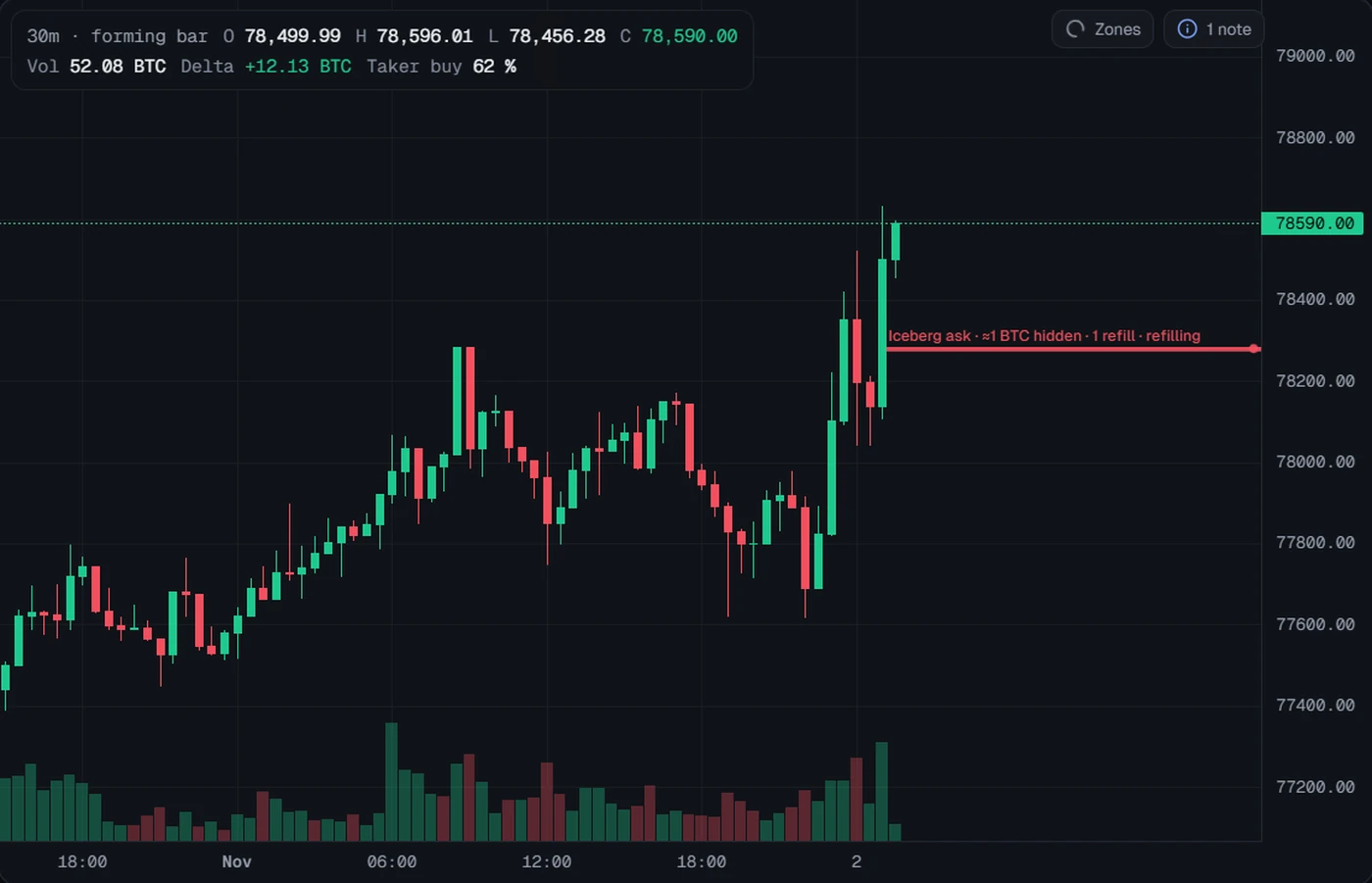
- What you see
- A thin line at the exact price that was defended, from where the zone formed to the right edge (the current price), like the other zones. Teal is a hidden buyer on the bid, red a hidden seller on the ask. The label reads, for example, Iceberg bid · ≈41 BTC hidden · 9 refills: a buyer kept refilling the bid nine times and traded at least about 41 BTC more than the book ever showed there. A brighter line means more hidden size; a dot means it is still refilling now.
- How to read it
- Iceberg bid (teal): a passive buyer absorbed selling at that price. Iceberg ask (red): a passive seller absorbed buying.
- ≈ hidden is a lower bound: what traded there minus the most the book ever showed and minus anyone who joined. The real order may be bigger.
- refills counts how often the shown size was eaten and came back within a second.
- refilling = still active now; broken = price traded through it with more size than it ever showed, or a bar closed beyond it: it is no longer a level and disappears from the chart. A zone with no fill for 24 hours fades and then shows only its size (≈30 BTC), so a week of them does not cover the candles.
- What it tells you
- That more size traded at one price than the book displayed, so part of the order was hidden. It is estimated from the best bid and ask and the trades. It does not tell you who it is, how much is left, whether one trader or several held the price, or that price will bounce there. Whether these prices hold more often than others has not been measured yet.
- How to use it
- Treat it like a level someone cared about. When price comes back, zoom in (1m) and watch the footprint and the tape at the price: fills that keep getting absorbed with price not moving through say the order may still be there; a close through it says it is gone (the zone turns broken).
- Common mistakes
- Assuming the order is still there. The zone shows what happened; the order can be cancelled at any moment.
- Reading the hidden size as the full order. It is a floor, not the total.
- Trading every zone. Most are small; one next to a heavy zone or a level matters more.
How a zone is made
- Watch the best price. Tactiq follows the best bid and ask with their sizes and every trade. Trades only happen at the best price, so deeper levels are not needed.
- Open an episode on the first passive fill at a price while it is the best on that side.
- Count refills and hidden size. A refill is the shown size eaten to 10 % or less and shown again within 1 second. Size added while size still rested is someone joining, never hidden size. A price that leaves the best without a fill and comes back is a market maker re-quoting, not a refill.
- Call it an iceberg when it refilled often enough, traded well above the most it showed, and the hidden size passes a minimum for the market.
- Merge into a zone. Iceberg episodes on one side within 2 ticks are one zone.
| Market | Refills (min) | Traded ÷ most shown (min) | Hidden (min) |
|---|---|---|---|
| BTCUSDT spot | 1 | 2.5 | 1 BTC |
| BTCUSDT perpetual | 3 | 2.0 | 2 BTC |
Spot needs only one refill because the exchange's own iceberg orders refill inside one taker order, so the quotes never show the refill: one fill far above the shown size is the sign. Perpetuals have no native icebergs and can hide retail-priced orders, so they need refills the quotes show. These minimums are provisional: they come from a few days of recordings and will be recalibrated.
An iceberg is patient liquidity, not proof of informed money. Studies of equity markets find icebergs are mostly traders who want to buy or sell without moving price. Tactiq keeps every episode so a forward study can measure whether these prices hold more often than others.